Inside the Final Hours of Life And Trust—and the Community It Left Behind
One year after its abrupt closure, the community that formed around Life And Trust remembers what was lost—and what continues.
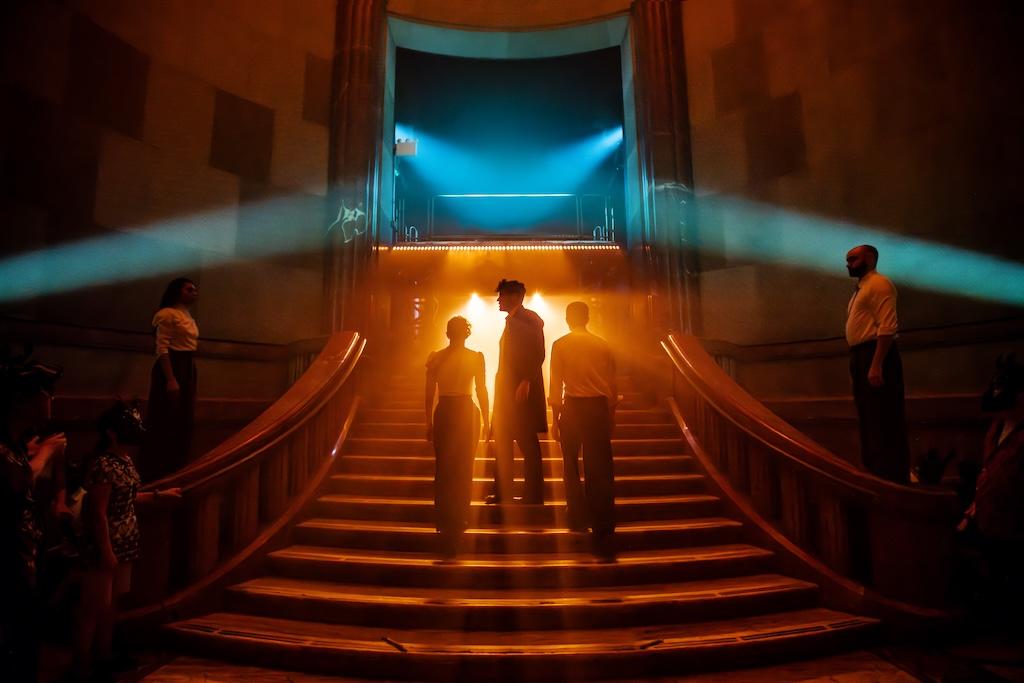
April Fools’ Day—typically reserved for pranks, lightness, and the temporary suspension of seriousness. This year, it arrives just days before Easter, a season associated with renewal, ritual, and return.
But for a particular community in New York, the date carries another weight.
It marks one year since the abrupt closure of Life And Trust, an immersive theater production in Manhattan’s Financial District that, for many, became more than a performance—it became a world.
I was in Watermill the night that became its last.
At a weekend family gathering where everything felt as it always had, predictably intact—long tables, low and joyful conversation, the quiet ease of a place specifically designed to keep the outside world at a distance. It is the kind of environment where urgency doesn’t belong.
Until it does.
In the early hours of the morning, my phone lit up. Then again. And again.
Messages from people I recognized instantly, and others I knew only through shared, silent experiences inside the show itself.
“Check the website.”
No context. No explanation. Just urgency.
Within minutes, the reality became clear: Life And Trust had closed. Suddenly. Without warning.
Within twenty-eight minutes, I was in my car.
I left without ceremony. The house behind me remained warm, lit, unchanged—as if nothing had happened. And for most of the world, nothing had.
But for those connected to the show, something that lived within us ended.
The drive from Watermill to Manhattan is long enough to process and question, and too short to fully accept. The LIE stretched ahead in near silence, and with every mile, the possibility of finality crept in more heavily.
By the time I arrived downtown, people had already begun to gather.
Not outside—but inside the coffee hall.
The doors were open. The lights were still on.
And what struck me immediately was how untouched everything felt.
The cast portraits still hung along the walls, exactly as they had the night before. The flags still flew. Nothing had been taken down, nothing had been softened or prepared for closure. It was as if the space itself had not yet been told what had happened.
People moved through it quietly.
Some speaking in low tones, trying to piece together information. Others simply standing still, taking it in. There was no announcement, no staff guiding the moment—only a shared understanding that something significant had just been lost, and that no one had been given time to prepare for it.
And yet, even in that abruptness, something else was happening.
People were finding each other.
Conversations formed between individuals who, hours earlier, might have only recognized one another in passing. Stories were exchanged—favorite moments, specific scenes, fragments of moments that had stayed with them. In the absence of the show itself, the experience was being preserved in spirit collectively, piece by piece.
It became clear, very quickly, that what had been created inside Life And Trust extended far beyond its walls.
That was not accidental.
It was the result of the Artists.
The performers who gave themselves fully to roles that required not just technical precision, but emotional exposure and raw vulnerability in front of and in close proximity to strangers. The designers and builders who constructed a world so detailed it invited exploration, curiosity, and immersion. The crew and staff who maintained and crafted that world night after night, often invisibly, ensuring that it remained seamless, alive, and believable.
What existed there was not simply a production.
It was a collaboration—between artists and audience—that allowed something unusually deeply personal to take place within a public space.
That kind of work does not happen by accident. And it does not happen without intention, discipline, and care.
The closure was sudden. Official explanations were limited. But the impact was unmistakable.
What I witnessed that morning was not just disappointment and grief and anger—it was evidence.
Evidence that the work had reached people.
That it had stayed with them.
That it had, in ways both subtle and profound, changed how they experienced connection, presence, and even themselves.
Art is often described as powerful. Transformative. Capable of moving people.
Standing there, in that coffee hall, surrounded by this community, those words felt less like abstractions and more like observable fact.
Because even in its absence, the work was still active.
Still connecting people. Still shaping conversation. Still being carried forward by those who had experienced it.
And that is something worth acknowledging clearly.
To the artists, the crew, and the staff who built and sustained Life And Trust—what you created matters.
It matters in ways that extended beyond the performance itself, beyond the space, and beyond its final night.
A year later, that remains evident.
Not in what was lost.
But in what continues.